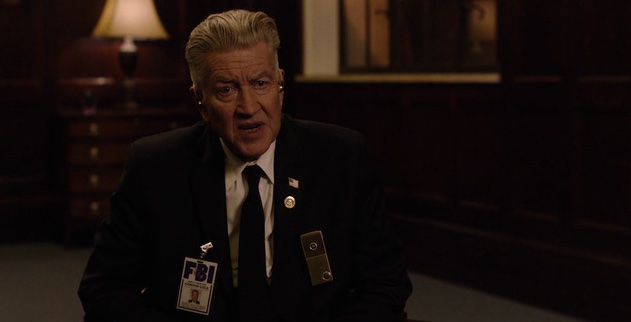
David Lynch died last week. Twin Peaks is possibly my all-time favourite TV show, but it wasn’t until the tributes started to pour in (and at one point on that Thursday night, my Bluesky feed was nothing but David Lynch tributes) that I discovered how Lynch’s own character Gordon Cole’s line to David Duchovny’s trans character Denise Bryson (“When you became Denise, I told all of your colleagues, those clown comics, to fix their hearts or die”) had led to “fix your hearts or die” becoming a rallying cry for the trans community. I knew that there had been a lot of discussion over the years about the inclusion of Duchovny’s character in the show – the clumsiness of its handling by modern standards (the introduction of the character being played for laughs, the casting of a cis man for the role) undercutting an otherwise positive representation of a trans character (Kyle MacLachlan as Agent Dale Cooper’s warm and almost immediate acceptance of Denise setting the example for his more dubious colleagues), but I’m pleased that something so positive has come from what were doubtless Lynch’s good intentions. I’m going to need to do another Twin Peaks marathon now.
I’m a big believer in representation – and in getting it right. It shocks me how moved I still am when I see LGBTQ+ representation done well. I thought I’d go through some of the characters that have meant a lot to me, to try to tell the story of how TV has helped me understand myself and given me a boost when I’ve needed it.
Queer as Folk
In the Definitive Collector’s Edition DVD boxset of Queer as Folk (yes, I own a copy), there’s a clip from a T4 promo featuring a very youthful Dermot O’Leary interviewing Charlie Hunnam and Craig Kelly, two of the three principal actors in the show. O’Leary’s co-host Margherita Taylor introduces the show as being about “three guys who happen to be gay”. It’s a very Channel-4-in-the-nineties right-on description, which misses the point by a mile: this was a programme where the gay wasn’t incidental, it was the whole point of the show, right there in the title (Russell Davies apparently wanted to call it “Queer as Fuck”, which would have been beautifully unsubtle).
I watched the show in my bedroom, volume turned down low so that my parents couldn’t hear. The eye-popping sex scenes in the first episode between 29-year-old Stuart (Aiden Gillen, long before he started appearing in everything) and 15-year-old Nathan (played by 18-year-old Hunnam) were understandably controversial, and as a 15-year-old myself in those dial-up modem days, it was the closest I’d got to watching porn. I was hooked.
It’s hard to say, now, who I most associated with in that show. Nathan was an obvious choice, being my age and just coming out of the closet, but he was far more rebellious than I ever was, smoking and talking back to his homophobic teacher. Vince was probably closer to the mark: he was closeted in his workplace, scared that his colleagues would find out, and terminally single, stuck with his unspoken, unrequited crush on Stuart. He was also, though, very much a part of the gay scene, partying every night and taking drugs in a way that I never was.
Still, it gave me something to aim for. The second series, the two-part Queer As Folk 2, was darker and angrier, seeing Stuart blowing up cars and (spoiler alert!) ending with him in America, holding a gun to the head of a redneck who’d dared to call him a faggot. It was, for me at least, an almost literal call to arms, and while I didn’t exactly go on a crime spree after watching it, I did come out to a number of my friends that night, determined, in those few hours at least, to be louder and prouder from that day forth.
Beautiful Thing
Beautiful Thing was released before Queer as Folk, but I didn’t watch it until much later on. It’s been a while since I’ve seen it, but I rewatched it so many times when I first discovered it that certain scenes are etched into my retinas. Unlike in Queer as Folk, the gay characters are anomalies in an otherwise straight universe, one that doesn’t stretch much further than the council estate where the boys grow up.
Doubtless I watched it so many times because I fancied the main actors and wanted to keep seeing Ste’s bum, but there was definitely something special about the closing scene that to this day makes my heart both ache and soar. Watch the boys hold each other, watch the neighbours torn between dancing along and grumbling, and watch as Ste’s mum glares at them all as if to say, “Try it”. If I ever get married, I know what the first dance will be to.
Coronation Street – Todd Grimshaw
I went through Coronation Street phase at university, starting to watch primarily because I’d read in Heat magazine that one of the characters was turning gay. Todd Grimshaw, at the time played by Bruno Langley, had already tried to kiss Nick Tilsley (who was having none of it, what with his sister being pregnant with Todd’s baby and all) but then Todd met Karl, who was actually gay and wanted to kiss him back. There was a slow build-up of flirtation and sexual tension over the course of a few weeks, and then I tuned in excitedly to see the much-hyped episode where the two of them were to lock lips on Manchester’s Canal Street.
As you can see on the video, my excitement was a little misplaced. They did kiss, or at least I’m pretty sure they did, but at the point that their mouths touched the camera panned away at such a pace that the cameraman must have needed a neck brace afterwards. Such was the climate, still, in 2003. It struck me after the event how deflated I was by this; I’d like to say I was disappointed by the cowardice of the show’s producers, but in reality it was something more personal than that. I was, I think, living vicariously through Todd, or maybe Karl; I fancied Bruno Langley, basically, and I wanted to see him kissing another guy. I suppose you could argue that it did go deeper; that I felt some attachment to the character, empathised with him, and wanted believe that things could work out for people like us. But, as I say, I was probably a bit horny as well.
Locke and Key – Duncan Locke

Netflix’s Locke and Key, based on the comic books by Joe Hill and Gabriel Rodriguez, was so far up my street it may as well have been parked in my garage. Fantasy, a big old creepy house in New England, magic keys, abandoned caves: basically everything that I look for in a show or film or book or life.
The gay representation here is comparatively minor, but in some ways that’s kind of the point. The character is Duncan, younger brother of the Locke children’s late father Wendell, who helps the family settle in to Locke House, the old family home, when Wendell is shot dead by a former student. He’s played by Aaron Ashmore, who you might recognise as Bobby Drake from the X-Men films, except you don’t because actually that wasn’t him, it was his identical twin brother Shawn.
First of all, massive props to Joe Hill for calling the uncle character Duncan (who in the world wouldn’t want a gay Uncle Dunc?), but also for including a character who’s gay and whose nieces and nephews think he’s awesome. Again, this might not seem much, but having grown up in a house where homosexuality was something you hid from kids in case they caught it, seeing teenagers and kids just accept him and get excited about his wedding to his boyfriend feels kind of special to me. In the original comic books (which of course I went out and bought), there’s a bit where the eldest of the Locke children, Tyler, is stuck inside a car boot with Duncan.
“As a gay man,” says Duncan, “I have to say I’m awesomely uncomfortable to be sharing an intimate moment in the trunk of my car with my beloved nephew. I never wanted to be that gay uncle.”
“I ain’t worryin’ about it,” replies Tyler. “I’m secure in my sexuality.”
In some ways that exchange seems quite heavy-handed now, and the TV show never really goes anywhere near this kind of conversation: instead the kids just love and accept and hug their Uncle Dunc pretty much any chance they get. It’s a nice moment, though, in that it encapsulates the difference between my generation, brought up to feel like we’re a taboo and on the defensive in case anyone thinks we’re going to molest their children, and the generations to come who give an awful lot less of a shit than we do. Which brings me to…
Stranger Things – Will Byers
In which actors twenty years younger than me play characters who, given that the series starts in 1983, would be a good ten-fifteen years older than me. Poor Will Byers has to come to terms with his sexuality in small-town America in the middle of the 1980s and, despite pretty much all the pop stars of the time being camper than Christmas, his peers seem to be oblivious to the very idea of his homosexuality.
“Will is painting a lot,” writes Eleven to Mike at the start of Season 4, “but he won’t show me what it is he is working on. Maybe it is for a girl? I think there is someone he likes, because he has been acting… weird.”
The revelation of the painting, in the back of a camper van driven by Will’s brother Jonathan, is for me just about as perfect a scene as you can get. It’s the moment when Will more or less confesses his feelings for Mike but hides it behind a description of Eleven’s feelings for Mike instead. Will’s description of how he feels, his brother’s realisation of what he means, Mike’s utter obliviousness… when Will starts crying so quietly, but so hard, I’m sure I wasn’t the only one crying along with him.
A number of LGBTQ+ people on the internet accused the programme makers of “queerbaiting” when this episode came out, of drawing in LGBTQ+ viewers while not explicitly dealing with Will’s sexuality. I felt very, very old when I read this. For me, the unspoken nature of the scene is what makes it so perfect: how many times have I felt that strongly about someone, all the time knowing that there was no chance of it ever happening, and feeling that to admit to them would destroy what little closeness I had with them? No other scene or actor has come close to conveying that as well as Noah Schnapp did in Stranger Things. Perhaps, though, I should feel glad to now be living in a world where this kind of repression is so foreign to a younger audience.
The Great North – Ham Tobin
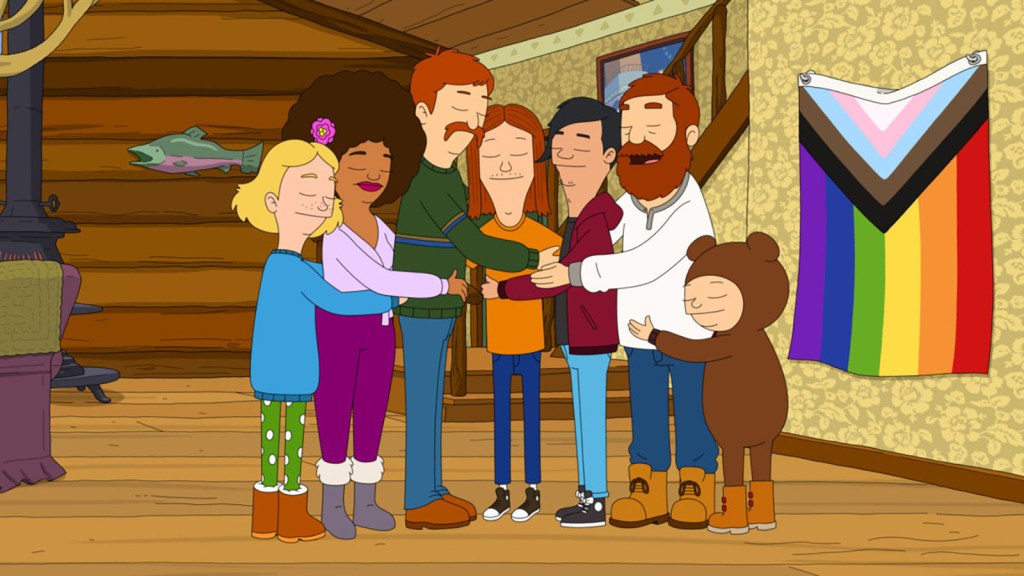
The Great North is made by the same people who make Bob’s Burgers, and while I’m not sure if it’s quite as good, I think I enjoy it more. First of all, the Alaskan scenery (snowy forests, mountains, log cabins) makes me want to move there immediately. It also features my new favourite gay character, Ham Tobin, who comes out in the very first episode.
“I am gay!” he announces to his family on their fishing boat.
“Ham, we know,” says his little brother Moon. “You’ve come out to us a bunch of times.”
“I have?”
“Yes,” says Ham’s dad Beef, voiced by Nick Offerman, “and we love you just the way you are, dammit!”
He gets together with his boyfriend Crispin a few episodes later. (At the time of writing I’m only partway through Season 2, and if it turns out that those two split up in any later episodes I swear I will be tracking the writers down and beating them with a set of moose antlers.) Again, it’s weird how unusual it feels to see two cartoon teenage boys kissing and holding hands, and how it really shouldn’t, but their relationship soon becomes as much part of the scenery as the aurora borealis and its ghostly vision of Alanis Morrissette (really, you need to watch it) and I honestly love the show for it.
There are more I could have mentioned (David and Noah in Schitt’s Creek, the time I sobbed at Mitch and Cam’s wedding in Modern Family) but these six are the ones that have made the biggest impact on me personally – and I’ve picked the personal ones because I wanted to show, through my own connections to these characters, the difference good representation can make. I’m very aware that I’ve ended up with a list of almost entirely white cisgendered men, but that’s probably down to my own white, cisgendered maleness. I hope, whoever you are, that out there there are characters that you can relate to in the same way and make you feel more seen and less alone.



 Questioning
Leave a reply to Pride and Shame – Questioning Cancel reply